Real Estate Investing
We help you close with in-house financing, rate buy-downs, two free years of property management, and three months of rent protection, so your passive income plan starts strong from day one.

We help you close with in-house financing, rate buy-downs, two free years of property management, and three months of rent protection, so your passive income plan starts strong from day one.

Strong, Consistent Demand
Housing is a fundamental need - demand is steady across market cycles.
The US faces a shortage of 3.2 million homes as of 2023 (Freddie Mac), driving long-term rental and ownership demand.
Reliable Income Stream
Residential properties generate recurring rental income that often outpaces inflation.
As of 2024, the average US rental yield is ~6-8% (iPropertyManagement)
Appreciation Over Time
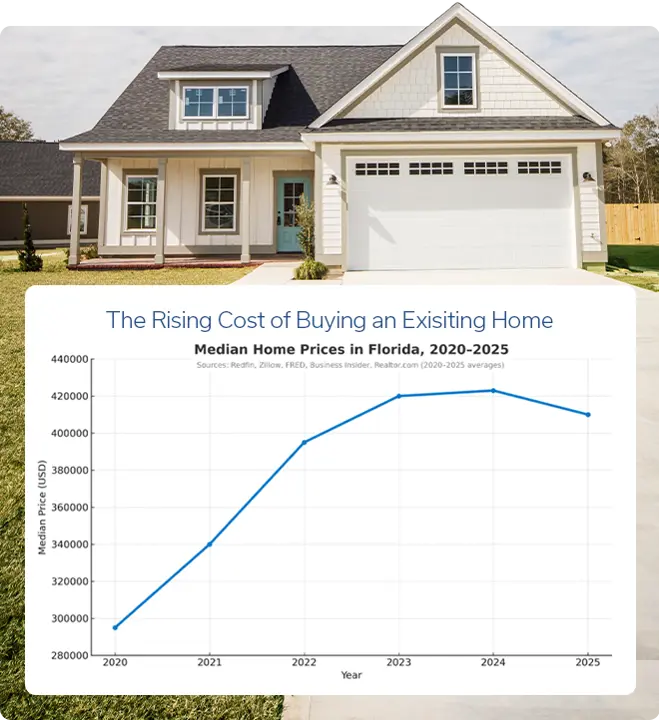
US home prices have appreciated an average of 5.56% annually since 1970 (FHFA).
Even during downturns, housing tends to rebound and recover value faster than many other assets.
Leverage Advantages
Investors can control a large asset with relatively little equity - eg., a 20% down payment can secure 100% of the property.
With modest appreciation (3%/year), leveraged returns on equity can hit 15%+.
Tax Efficiency
Depreciation, mortgage interest, and operating deductions lower taxable income.
1031 Exchange allow investors to defer capital gains when reinvesting in new properties.
Inflation Hedge
Historically, rents and property values rise alongside inflation.
A study by the National Association of Relators found housing has one of the highest positive correlations with inflation among major asset classes.
Portfolio Diversification & Stability
Real estate has low correlation with stocks and bonds (Nareit).
Institutional portfolios with real estate show reduced volatility and more balanced risk-adjusted returns.
Scale Flexibility
Individual Investors can start with a single rental or syndication.
Corporate Investors can strategically expand into workforce housing, employee housing, or rental income streams.
Private equity & institutions can squire portfolios, build-to-rent communities, or multi-family developments.

Lower Maintenance & Repair Costs: Less capital spent on upkeep = higher net returns
Builder Warranties & Peace of Mind: Protects cash flow in the critical ear years of ownership.
Higher Rental Appeal & Premium Rents: Attracts better tenants and reduces vacancy risk.
Energy Efficiency = Cost Savings: Lower costs improve tenant satisfaction and reduce turnover.
Financing & Appraisal Advantages: Smoother, faster closings with less hidden risk.
Stronger Appreciation Potential: Captures upside from area growth.
Tax Incentives: Maximizes after-tax returns
Exit Strategy Advantage: Provides flexibility to sell at stronger margins.
Dimension | S&P 500 Index | Residential Rentals |
|---|---|---|
Cash flow | Dividends only | Monthly rent (net after expenses) |
Leverage | Limited/margin | Common via mortgages |
Volatility | Higher (daily swings) | Lower (price updates monthly/quarterly) |
Taxes | Dividend/cap-gains rules | Depreciation + interest deductions |
Inflation link | Indirect | Rents & rebuild costs often rise with CPI |
What real estate adds
Cash flow today: Monthly rent can offset mortgage, taxes, insurance, and management-unlike stocks, which require selling shares to realize income. In 2024, average gross rental yield on 3-bed SFRs was ~7.55% across analyzed U.S. counties. ATTOM+1
Leverage that works for you: Fixed-rate debt lets tenants help retire principal; small price moves on the asset can translate to larger equity gains on your invested cash (not typically available in an index fund).
Lower observed volatility: Academic work finds annual house-price return volatility around ~5%, versus ~18% for the S&P 500 - producing a higher rust-adjusted profile in the sample studied. MDPI
Tax advantages: Depreciation and interest deductions can improve after-tax yield (confirm specific with your CPA).
Inflation alignment: Rents and replacement costs ten to move with inflation, supporting real income over time. Recent research continues to evaluate real estate's inflation-hedging behavior. Science Direct
How returns stack up
S&P 500 (long-run): ~10-11% average annual return before inflation; real (after-inflation) averages are lower. Trade That Swing+2
Home prices (long-run appreciation): U.S. Case-Shiller National Index shows ~4.26% average annual growth (price only, excludes rent). Cash flow from rent is additive to this. YCharts.
Bottom line: If you want pure market beta and daily liquidity, the S&P 500 is hard to beat. If you want income + amortization + tax benefits + generally smoother ride, residential rentals can be a powerful complement-or core-depending on your goals.


“My company has invested over $40 Million into real estate deals with Jim and had great success. | also consider him one of my top advisors when it comes to living a legendary family life. He's a crowd favorite at our annual event."

Individual Investors partner with SIH to access turnkey opportunities designed to generate long-term rental income and portfolio growth.

Capital Investors partner with SIH to deploy capital into scalable residential real estate opportunities backed by disciplined execution and proven performance.

Scalable residential investment solutions designed to meet the performance and operational needs of institutional investors.